The Perfect Seat Is a Myth: Choose by What You Notice
Choose a cinema seat by distance, sightline and sense of company, so you can settle into the film without chasing someone else’s idea of the best place.
The most common cinema-seat mistake is treating the middle of the room as a universal target; it can leave you craning at a screen that feels too large, or marooned when you wanted the company of a crowd. A better seat depends on what you notice while watching, not on a rule passed along as if every filmgoer sees in the same way.
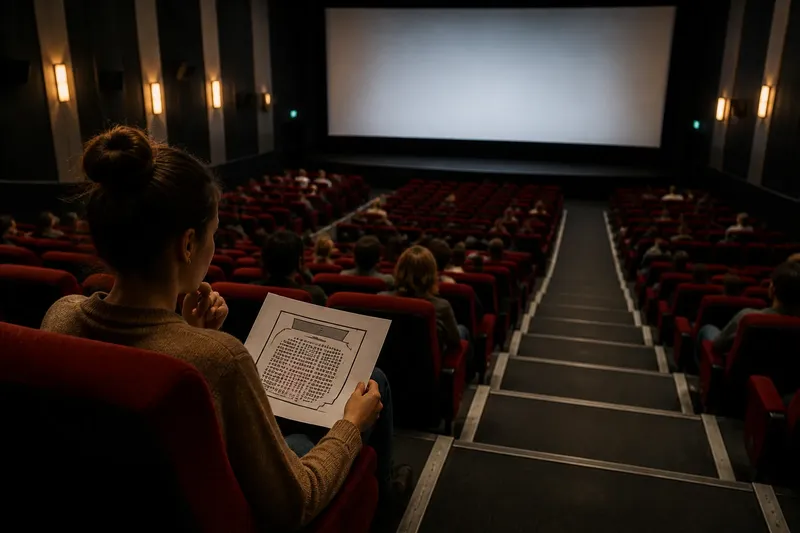
Consider an invented situation: Mara is choosing seats for a fictional evening screening at the fictional Alder Row Cinema. She likes to read faces and follow quiet dialogue, but she also enjoys hearing the room react. The auditorium plan shows a large screen, several seating blocks and a wide aisle between them. Rather than pick the central pair by habit, Mara works out which parts of the experience matter most to her.
Choose a cinema seat by what holds your attention
“Best seat” can mean a comfortable viewing distance, a balanced view of the image, or the feeling of being among other people. Those preferences overlap, but they are not identical. A seat can be close to the visual centre and still feel wrong if its distance makes the screen dominate your attention.
Start by naming what you tend to notice. Do you track small expressions, scan broad action across the frame, listen for dialogue, or respond to laughter and gasps around you? Your answer gives you a useful priority before the seat map tempts you with neat rows and a highlighted centre.
Mara’s first priority is seeing faces without having to search for them. Her second is sharing the audience’s reactions. She does not need to be exactly in the middle; she needs a seat where those two preferences can coexist.
Use distance to decide how much screen you want
Distance changes the character of a screening. Near the front, the image can occupy much of your field of view, which may suit someone who wants to feel surrounded by the screen. Farther back, it is easier to take in the whole composition at once and shift attention between the image and the room.
There is no single distance that works for every auditorium or viewer. Screen size, row layout, personal comfort and the film’s visual style all matter. A close seat may feel lively during an expansive image, yet become tiring if you prefer to follow the whole frame without turning your gaze often.
Use the seating plan to compare rows rather than relying on a label such as “premium” or “sweet spot”. If you have visited the venue, recall whether you naturally leaned forward, looked from side to side or wished the screen felt nearer. If you have not, favour a position that leaves you room to adjust your gaze instead of committing to the most extreme front row.
At Alder Row, Mara rules out the first rows because she would rather hold the whole image in view. She also avoids the very back: she wants expressions to remain prominent. The middle portion of the auditorium becomes a range to consider, not a magic row.
Check the sightline, not just the seat’s position
A seat’s place on a plan does not tell the full story. The screen may sit higher or lower than you expect, a balcony may alter the angle, and a person in front can interrupt a view. Look for the venue’s seating notes or accessibility information, and consider whether an aisle, rail or projection booth could affect the line of sight.
Seats near the side can be a sensible choice when the auditorium is wide, but the screen may look angled from an outer position. Some viewers hardly notice that perspective; others find it distracting. If you are sensitive to tilted lines or uneven framing, choose a seat nearer the centre of its seating block rather than the outermost edge.
Also think about what you want to see in the frame. A film built around broad movement may reward a view that takes in the full width, while a close, dialogue-led film may draw you towards faces. This is not a reason to predict every scene. It is a prompt to match the seat to the kind of attention you enjoy giving.
Mara studies the map and chooses an aisle seat within the central block, slightly off the exact centre. From there, she expects to keep the image comfortably in view while having a clear route to the exit. Her choice is a preference, not a claim that the neighbouring seat would be wrong for everyone.
Decide how much company you want
A cinema audience is part of the experience, even when nobody speaks. A shared laugh can make a comedy feel more buoyant; a hush can sharpen a tense scene. If you like that collective presence, a seat among other viewers may suit you better than a sparsely occupied corner.
Company does not have to mean sitting in the busiest cluster. You may want to sense the audience without being shoulder to shoulder, or prefer a quieter edge while still feeling part of the room. The choice can change with your mood, the film and whether you are attending alone or with someone else.
For a group, look for a row where everyone can sit together without making one person accept a view they dislike. If seats are split, decide whether staying together matters more than each person’s preferred position. For a solo visit, an aisle seat can offer a little breathing room, while a seat embedded in a row can make the audience feel closer.
Mara is going alone, but she does not want a solitary-feeling corner. The central block offers the audience presence she enjoys, and the aisle gives her a clear boundary on one side. She chooses that balance rather than assuming that the fullest section must be the most sociable.
Make a seat choice from the booking map
A booking map is a rough tool, not a view through your future eyes. Use it to narrow the options, then make a simple decision based on the things you already know about your preferences.
- Set your distance preference. Decide whether you want the screen to fill your attention or the whole image to sit comfortably in view.
- Find a useful sightline. Check the seating blocks, screen position and any venue notes that identify restricted or unusual views.
- Pick your company level. Choose between a seat among the audience, a quieter edge or a position that gives you more space.
- Account for your group. Decide whether sitting together or securing each person’s preferred view matters more for this outing.
- Keep one alternative. If your first choice is unavailable, select a nearby seat that preserves your main priority rather than starting the decision over.
- Use past visits as clues. Remember what you noticed in other auditoriums, but treat that memory as guidance rather than a fixed rule.
Imagine Mara opens the map and finds her preferred aisle seat is taken. She chooses a seat one section closer to the centre, rather than moving to the front to stay near the aisle. The expected observable result is a view that remains close to her main preference, even though it is not her first pick.
Which cinema seat suits your viewing style?
Is the middle of the cinema always best?
No. A central seat often gives a balanced perspective, but the best choice for you depends on distance, sightline and how much audience company you want. Treat the middle as one option to assess, not a rule.
Are front-row seats a bad choice?
Not necessarily. They can suit viewers who like an immersive, screen-filling image, but may feel too close if you prefer to take in the full frame at once. Choose them for the experience you want, not because an empty front seat happens to be available.
Should you sit near an aisle?
An aisle can make entry and exit simpler and leave one side more open, which some people find comfortable. It may also bring passing movement into your peripheral view, so weigh that against the convenience you value.
Where should you sit for a film with subtitles?
Choose a position from which you can read the subtitles without losing track of the action. If you tend to move your eyes between text and faces, a moderate distance and a clear, less angled view may feel easier than an extreme front or outer-side seat.
Let the result teach you your own preferences
After the screening, recall what you noticed rather than judging the seat with a single verdict. Did you feel close enough to read expressions? Could you take in the full frame? Did the audience make the film feel more shared, or did nearby movement pull your attention away?
Mara leaves with a useful distinction: she liked the audience presence, but she would choose a seat closer to the centre next time if the film depended on subtle visual detail. That is not a universal ranking of rows. It is a clearer description of how she watches.
Keep the lesson brief and specific. “I wanted more distance” is more useful than “the seat was bad”; “I liked the quiet edge” says more than “the cinema was too busy”. When you search for a cinema seat, choose by what you notice, then let each visit refine that preference. A good seat is the one that lets your attention stay with the film.